When Saul Bass released Phase IV in 1974, audiences expected a standard ecological horror film about mutant ants overrunning humanity. What they got instead was something stranger: a slow, geometric meditation on communication, evolution and intelligence.
Yet beneath this peculiar narrative lies a deeper conversation about the power relationships between humanity, nature, and technology, one that sets the stage for an exploration of dominance, cooperation, and coexistence.
I think I watched it in my early teens, on one of its rare forays onto BBC2’s late-night programming. It’s been one of my favourite films since, not just because I was young and impressionable (OK, yes, I was) but also because it’s a film with a lot of strangeness.
For most of its running time, the film feels like it’s building towards a standard man vs monster movie, but then veers off into a bizarre direction. The ending as released wasn’t Bass’s choice. Paramount forced him to replace his original (and longer) finale with a short, ambiguous scene that ultimately cuts to black. The result feels abrupt and unsatisfying. It was a film about communication that ended in silence.
Its original ending, rediscovered decades later, reveals something much more interesting. Humanity isn’t destroyed by the ants so much as absorbed into their collective consciousness. It’s not an apocalypse, but a synthesis, a transformation facilitated by adaptation and complex feedback mechanisms. The ants’ collective intelligence operates as a dynamic system in which human and ant behaviours adjust and adapt to each other, leading to a phase shift. This synthesis reflects a cybernetic paradigm in which both entities evolve into an integrated system, echoing the principles of cooperation and balance within evolving environmental and technological landscapes.
This is something I’ve been thinking about a lot: how our visions of the relationship between nature, humanity and technology are driven by (amongst other things) the power relationships between people. Perhaps there’s something in the water.
Anyway, Bass’ original ending shows his real subject. Phase IV isn’t about insects, and it’s definitely not an insect horror movie. I think it’s actually about feedback. It belongs to a brief historical moment when cybernetics and ecology seemed to speak the same language — when thinkers like Gregory Bateson, Buckminster Fuller and Stewart Brand imagined a world of self-regulating systems in which man and technology might finally learn to coexist with nature.
Talking to the ants
There’s a scene that I think captures this. James Lesko, the younger of the film’s two scientists, sits at a console in his desert research dome, using a computer to try to talk to the ants. The language he uses isn’t words, or clicks and buzzes, but patterns. He uses pulses, tones, and geometric sequences fed into a machine that converts mathematical data into a signal.
Outside, the ants respond by building structures that echo the same logic. For a moment, the desert becomes a circuit board — life and machine speaking through the shared grammar of information. Watching it now, the scene feels less like science fiction and more like an artefact from an alternate timeline, one where computers evolved into instruments of dialogue rather than control, and where the dream of cybernetic ecology never soured into surveillance capitalism.
Machines of loving grace
That dream’s most hopeful expression came from Richard Brautigan’s 1967 poem “All Watched Over by Machines of Loving Grace.”, which I was reminded of recently. Brautigan imagined a future where “mammals and computers live together in mutually programming harmony”. This is pastoral networks, benign machines, cybernetic grace.
Bass and Brautigan were responding to the same cultural current, tapping into the post-war fascination with information flow and feedback, and the belief that intelligence might be a property of systems rather than souls. But where Brautigan is blissful, Bass always feels uneasy. His ants are graceful but profoundly alien. The old order collapses, and a new one absorbs it. The “machines of loving grace” are biological, but they are, if anything, even more alien and less like us than computers.
Entropy and order
Information theory framed life as a struggle against entropy, and of order dragged out from noise. In Phase IV, the ants embody this. They reorganise their environment into geometric precision, reducing chaos as they evolve. The humans, by contrast, introduce interference. When the system finally absorbs them, it regains equilibrium.
I think in some ways Bass’s film anticipates today’s distributed, data-driven world. The ants are a decentralised intelligence, a living algorithm. The scientists, isolated in their sterile dome, are old-model humans: rational, hierarchical, doomed. The feedback loop tightens until comprehension gives way to communication and ultimately to merger.
The lost future
Half a century later — at least in some techno-optimist views – our machines watch over us with a sort of algorithmic grace, at least if you believe “grace” involves being able to dropship cheap shit from China. Either way, the harmony Brautigan imagined never arrived. We built feedback systems without balance and connectivity without empathy.
(Sidenote: This is usually where I say “duh, capitalism” but I’m going to spare you that today. You’ll thank me.)
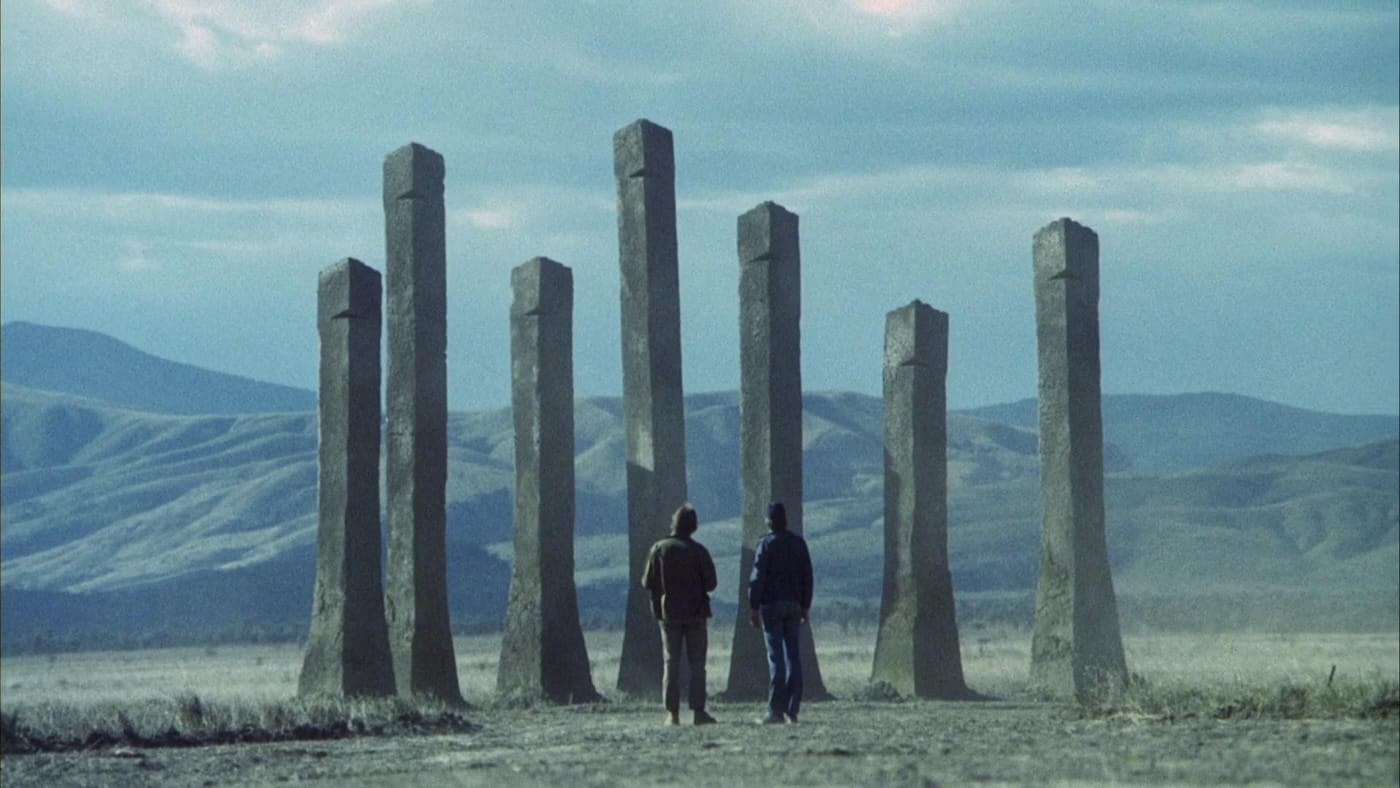
I think Phase IV endures not just because it’s a good film (it is) but because it captures a moment when technology still felt like it could be a part of nature. It was a point when designers, scientists, dreamers, drummers and hippies believed information might heal the rift between humanity and the environment. Its restored ending takes the film from dystopia to elegy, with the ants’ geometric columns rising like the Monolith from 2001: A Space Odyssey. It’s a vision of what might have been if we’d followed the line from cybernetics to ecology instead of the World Wide Web to commerce.
That dream now seems hopelessly naive, but watching Phase IV today is a glimpse of an alternate history in which communication replaced control and intelligence — whether carbon, silicon, or chitin — belonged to the same living systems.